

 Current position > Product detail
『Coriolis Flow Meter Pressure Drop Calculation: Engineering Friction Loss Math』Related information(clamp on meter|electromagnetic meter|venturi meterrotameter|orifice meter|ultrasonic flow meter|mass flow meter|coriolis mass flow meter|coriolis flow meter|magnetic flow meter|magmeter flow meter|magflow flow meter|mag meter flow meter|electromagnetic flow meter|vortex flow meter|turbine flow meter|thermal mass flow meter|thermal flow meter|rotameter flow meter)
Coriolis Flow Meter Pressure Drop Calculation: Engineering Friction Loss Math
Quick Answer: For a DN25 Coriolis flow meter running water at 20 °C and 2000 kg/h, the pressure drop is around 0.42 bar. At 4000 kg/h the same meter can lose about 1.46 bar because pressure drop increases nonlinearly with flow. Use the coefficient and exponent method from the manufacturer curve to check available pump head before you order a meter.
Why Engineers Check Pressure Drop Before Sizing a Coriolis Meter
Most engineers skip this part because the Coriolis meter has no moving parts and the pressure loss seems small. In practice, a DN15 meter can create more than 1 bar of pressure drop on a heavy syrup or crude oil line. That pressure loss directly reduces pump capacity. A desalination plant in Oman once found that a DN15 pilot meter added too much back pressure on a chemical dosing line. The plant had a 2 bar pump. The meter consumed 0.9 bar at 1200 kg/h. The remaining 1.1 bar was too low for the downstream static mixer. They changed to DN25 and the pressure drop fell to 0.2 bar.
Pressure Drop Variables and the Basic Calculation Method
Pressure drop in a Coriolis meter depends on mass flow rate, fluid density, viscosity, and the internal tube diameter and geometry. The meter flow path is not a straight pipe. It includes splitter sections, curved tubes, and sometimes a manifold. So a pure Darcy-Weisbach pipe friction calculation is not enough. Manufacturers often present pressure drop data as curves or as a simple power law equation.
ΔP = a * (Qm / 1000)^b
Where ΔP is pressure drop in bar, Qm is mass flow in kg/h, and a and b are curve fit constants for a given meter size and fluid.
For water and low viscosity fluids, the exponent b is usually between 1.7 and 2.0. That means pressure drop increases faster than flow. If you double flow, pressure loss can increase by a factor of 3.5 to 4.0. This is the main reason a meter that works at 2000 kg/h may not work at 4000 kg/h.
Worked Example: DN25 Meter on Water
A DN25 Silver Instruments Coriolis mass flow meter has a pressure drop coefficient a of 0.12 for water at 20 °C. The exponent b is 1.80. At 2000 kg/h the calculation is:
ΔP = 0.12 * (2000 / 1000)^1.80
ΔP = 0.12 * 3.48
ΔP = 0.42 bar
At 4000 kg/h the calculation changes:
ΔP = 0.12 * (4000 / 1000)^1.80
ΔP = 0.12 * 12.13
ΔP = 1.46 bar
So a DN25 meter is fine for 2000 kg/h but a DN40 is better for 4000 kg/h if the available pump head is below 2 bar.
Viscous Fluids and Laminar Flow Correction
The above formula works for water and fuels. For high viscosity fluids such as glycerin, palm oil, or syrup, the flow regime moves from turbulent to laminar. The pressure drop becomes more dependent on viscosity. A customer in Vietnam ran 1500 kg/h palm oil at 60 cP through a DN15 meter. The pressure drop reached 0.9 bar. The same DN15 meter on water at the same mass flow had a drop of 0.3 bar. We recommended a DN25 meter. The pressure drop dropped to 0.25 bar.
For viscous fluids above 50 cP,
Model Selection Based on Pressure Drop
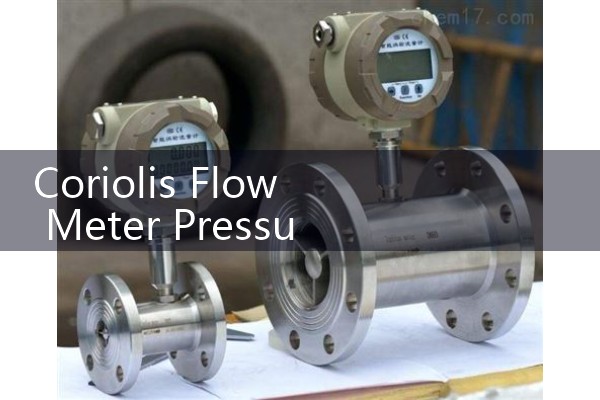
Silver Instruments CMF series Coriolis mass flow meters cover DN15 to DN200. For most water, solvent, and light oil applications, keep DN15 below 1500 kg/h water, DN25 below 4000 kg/h water, DN40 below 10000 kg/h water, and DN50 below 20000 kg/h water. This is a rough guide. The actual limit depends on the allowed pressure drop and fluid viscosity. A paint manufacturer in Southeast Asia replaced a DN15 turbine meter with a DN25 Silver Instruments Coriolis meter. The paint had a viscosity of 120 cP at 40 °C. The DN25 meter kept the pressure drop at 0.4 bar at a flow of 1800 kg/h. The line had only 1.5 bar available pump head.
The CMF series offers mass flow accuracy of 0.1 percent of rate, density accuracy of 0.0005 g/cm³, and outputs of 4-20 mA HART plus Modbus RTU. Hazardous area versions carry ATEX Zone 1 and IECEx certifications. This detail matters when you are putting a meter into a solvent loading skid or an offshore fuel line.
FAQ: Coriolis Flow Meter Pressure Drop
Question 1: What is a normal pressure drop for a DN25 Coriolis flow meter? For water at 2000 kg/h and 20 °C, a DN25 meter normally drops between 0.3 bar and 0.6 bar. At 4000 kg/h the same meter can drop 1.4 bar or more. Check the manufacturer curve for your fluid.
Question 2: How do I calculate pressure drop for viscous fluids? Use a viscosity-corrected pressure drop curve or calculator from the meter manufacturer. The power law formula for water is not accurate above 50 cP because the flow becomes fully laminar.
Question 3: Does pressure drop affect Coriolis meter accuracy? Pressure drop itself does not change the mass flow accuracy. It reduces available line pressure downstream. If downstream pressure falls below the vapor pressure, the fluid can cavitate. Cavitation can damage the meter and cause measurement errors.
Question 4: Which meter size should I choose for 2000 kg/h water? A DN25 Silver Instruments Coriolis meter works well at 2000 kg/h water. The pressure drop is about 0.42 bar. If the available pump head is under 1 bar, use a DN40 meter.
Question 5: Can Silver Instruments provide pressure drop curves before a quote? Yes. Send your fluid name, viscosity in cP, density in kg/m³, flow range in kg/h, operating pressure in bar, and temperature in °C. We return a pressure drop calculation and a recommended meter size.
Request a Pressure Drop Evaluation
Send us your pressure in bar, temperature in °C, pipe size DN, flow range kg/h, and fluid viscosity cP. We will check the friction loss on a Silver Automation Instruments Coriolis flow meter for your process. Call +86-25-68650347 for a quick review. WhatsApp +86-25-52155837. WeChat +86 15365082610.